Cities are living organisms. They grow, adapt, and reinvent themselves in cycles that compress centuries of craft into months of construction. In this accelerated urban rhythm, customizable street furniture seating, planters, bollards, lighting bases, bicycle stands, water features becomes more than background infrastructure. It’s the tactile interface between people and place. With 3D printing and specifically 3D concrete printing (3DCP) we unlock a new grammar for these public touchpoints: a language of geometry, resource efficiency, and rapid iteration that rewrites how we design, fabricate, and maintain the city.
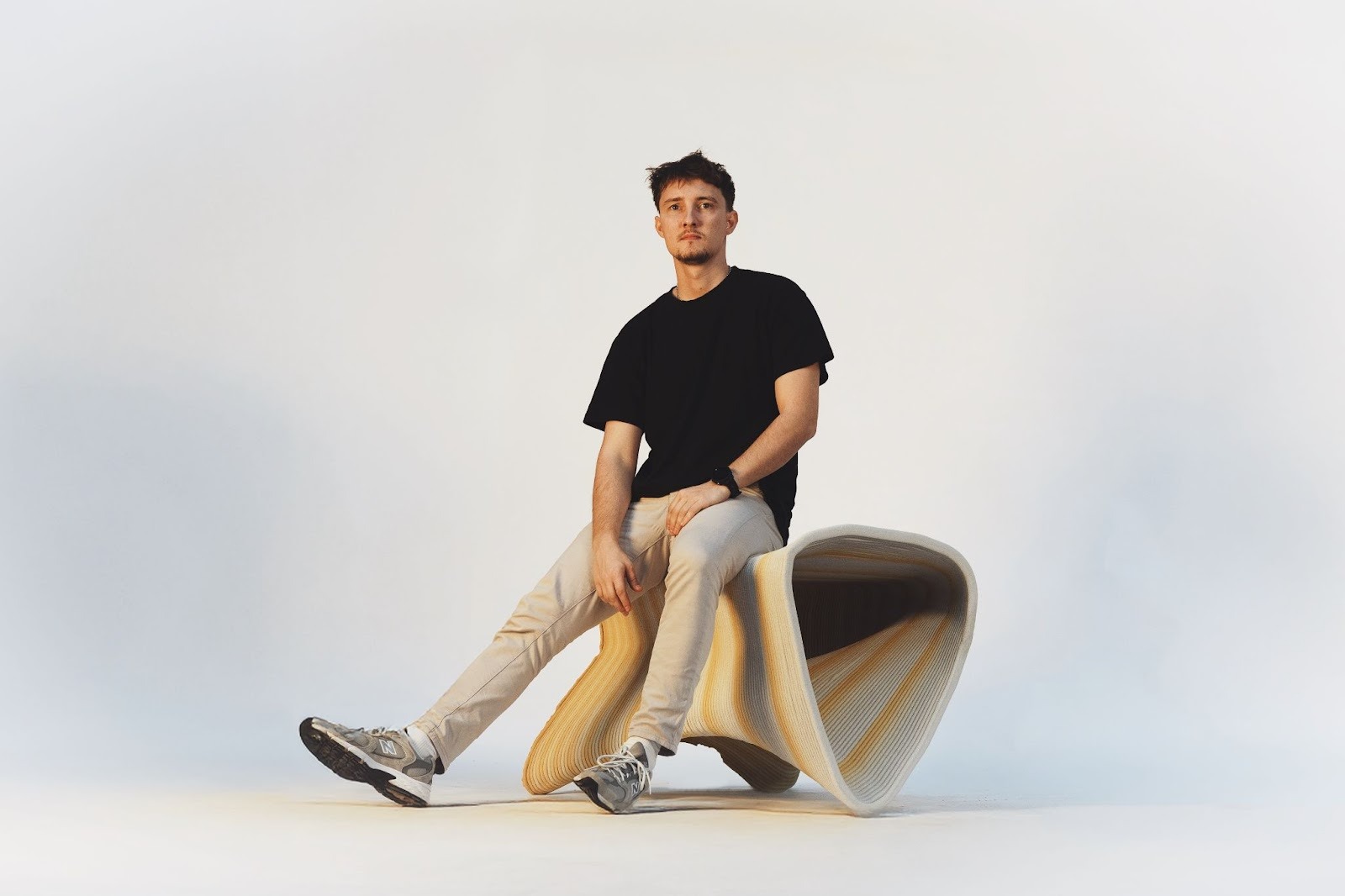
From Roman Forums to Robotic Arms: A Short Historical Arc
Public furniture has always been a measure of civic ambition. Marble benches signaled permanence; cast-iron lampposts embodied the Industrial Revolution’s repeatable precision; postwar concrete planters expressed modernity’s material honesty. Each era translated available technology into urban form.
3D concrete printing is the next chapter. Where casting required molds and standardization, robotic extrusion enables complexity without penalty. Where ornament once ballooned costs, data-driven patterns now emerge from parametric design scripts at near-zero marginal complexity. And where traditional methods struggled to reconcile custom design with tight budgets, digital fabrication scales customization as naturally as software.
The Engineering Logic Behind Freedom
At first glance, 3D-printed street furniture seduces with curves and gradients. But its true power is structural and environmental.
- Layered deposition: A robotic nozzle extrudes a printable mortar in beads, building up form layer by layer. This stratified geometry introduces micro-ribs and cavities that can act like corrugations, adding stiffness while reducing mass.
- Topology optimization: Generative algorithms remove material where stress is low and reinforce where it’s high. The result is skeletal, almost biological forms think trabecular bone that deliver strength with up to 30–60% less material than solid equivalents.
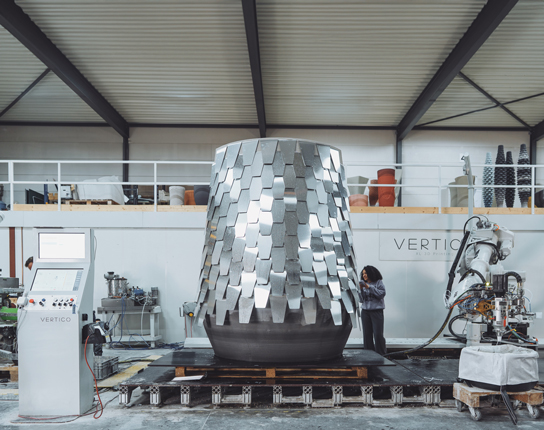
- Material tuning: Printable mixes balance rheology (pumpability, buildability) with curing kinetics. By tailoring aggregate gradation, fiber dosage, and admixtures, we achieve rapid green strength, sharp overhangs, and durable surfaces suited to public use.
- Embedded function: Sensor channels, conduits for lighting, drainage, or irrigation lines are simply “printed in,” not drilled after the fact. That reduces finishing work and preserves structural integrity.
In short, design freedom emerges from engineering discipline. You don’t “add” sustainability at the end you plan it into the toolpath.
Customizable Street Furniture, Defined
Customizable street furniture means systems designed to morph dimensionally, functionally, and aesthetically without retooling. With 3DCP, the same robot prints a 1.2-meter bench and a 30-centimeter bollard by swapping a script, not a mold. Libraries of parametric templates let urban designers adjust:
- Radius, height, and seat depth to fit site lines and crowd flows
- Texture and porosity to influence acoustics or promote plant growth
- Permeable cavities for weight reduction, ballast pockets, or integrated irrigation
- Color and finish via pigmentation or post-processing treatments
- Accessibility features contrasting edges, tactile cues, cane-detectable profiles baked into geometry rather than bolted on
This is design for context rather than design despite context.
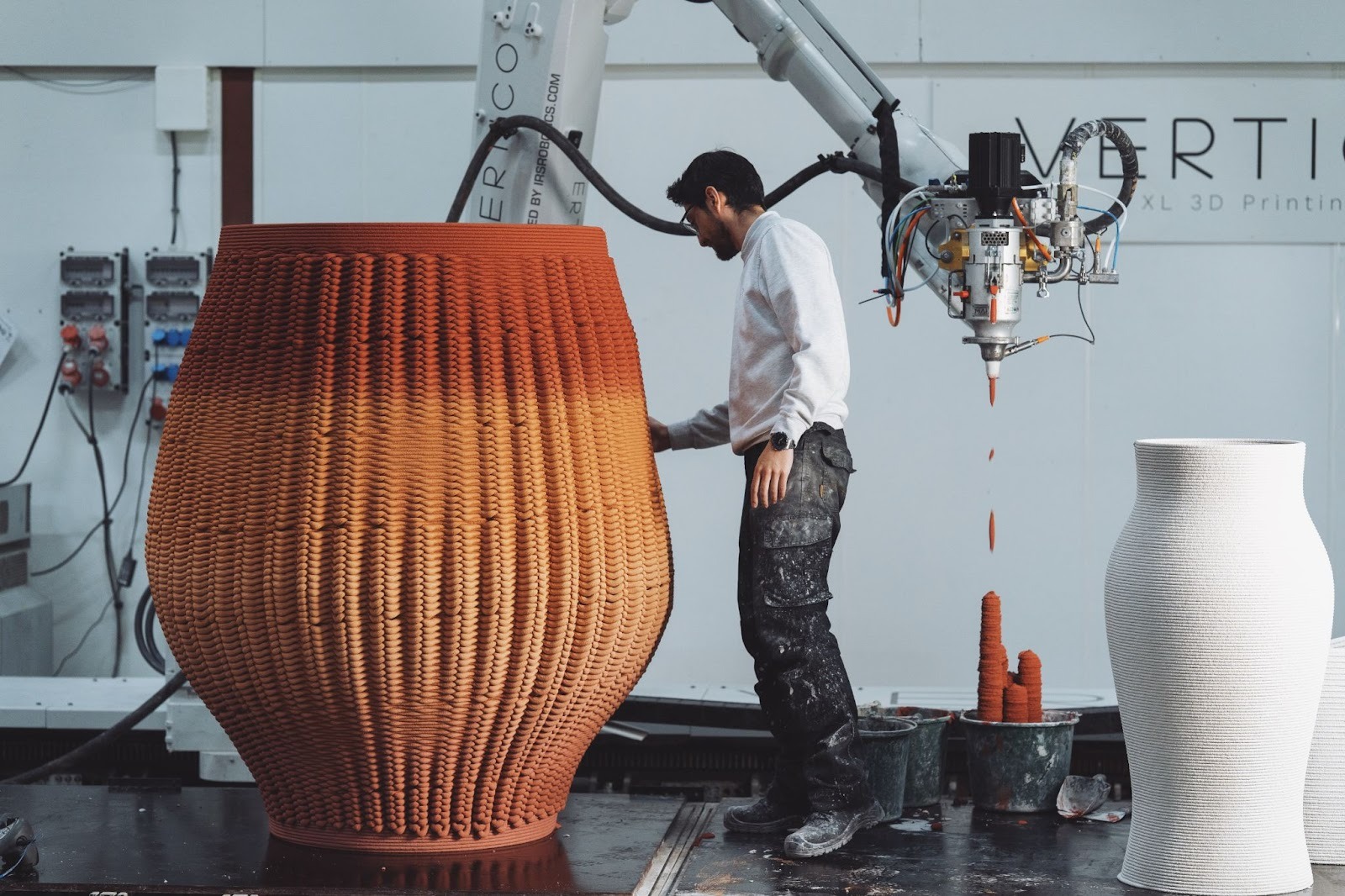
Materials: From Cement-Heavy to Circular and Low-Carbon
Concrete’s carbon burden is real, and responsible innovation tackles it head-on. In 3DCP, the levers are powerful:
- Cement reduction through supplementary cementitious materials (SCMs) like slag, fly ash, calcined clays, or finely ground recycled fines.
- Recycled aggregates from urban mining (e.g., crushed sidewalk or façade panels) screened to printable gradations.
- Fiber reinforcement (basalt, glass, steel, or polymer) to control shrinkage and enhance ductility without heavy rebar cages.
- Ultra-high-performance concrete (UHPC) zones only where needed at support points or thin spans using multi-material strategies.
- Admixture optimization to lower water demand and shorten print-to-handle time, reducing on-site energy and labor.
The sustainability equation extends beyond mix design. Because there are no molds, there is no formwork waste. Because parts are structurally efficient, there is less material to transport. Because geometries can be hollow with internal ribs, elements are lighter yet robust, trimming mounting steel and foundations.
A Parametric Workflow for Urban-Scale Customization
Think of the pipeline as a tightly coupled loop:
- Site Data Intake
Laser scans, drone photogrammetry, and GIS layers define curbs, slopes, utilities, and desire lines. This data anchors the design to reality. - Parametric Design & Generative Constraints
Architects manipulate high-level parameters seat length, curvature, ergonomic profiles—while an optimization layer enforces stress, deflection, ADA/ISO accessibility, and safety clearances. Variants are generated and filtered automatically. - Performance Simulation
Finite element analysis (FEA) evaluates loads: sitting, leaning, skate impacts, maintenance vehicles. Wind, freeze–thaw, and vandalism scenarios are tested. Drainage and thermal cycles are modeled. - Toolpath Strategy
The geometry is rationalized into bead widths, layer heights, and nozzle paths. Overhangs are tuned to the mix’s thixotropy; pauses for interlayer bonding are scripted; embedded conduits and sleeves are reserved. - Robotic Printing & Curing
Elements are printed near-site or in a microfactory. Curing regimes humidity tents, CO₂ curing, or accelerated steam are selected for strength development and carbon uptake. - Assembly & Commissioning
Quick-connect anchors, tamper-resistant fasteners, and alignment fixtures speed installation. QR-coded elements link to digital twins for maintenance, provenance, and future reconfiguration.
The result is mass customization without chaos a repeatable, auditable process that turns custom into standard.
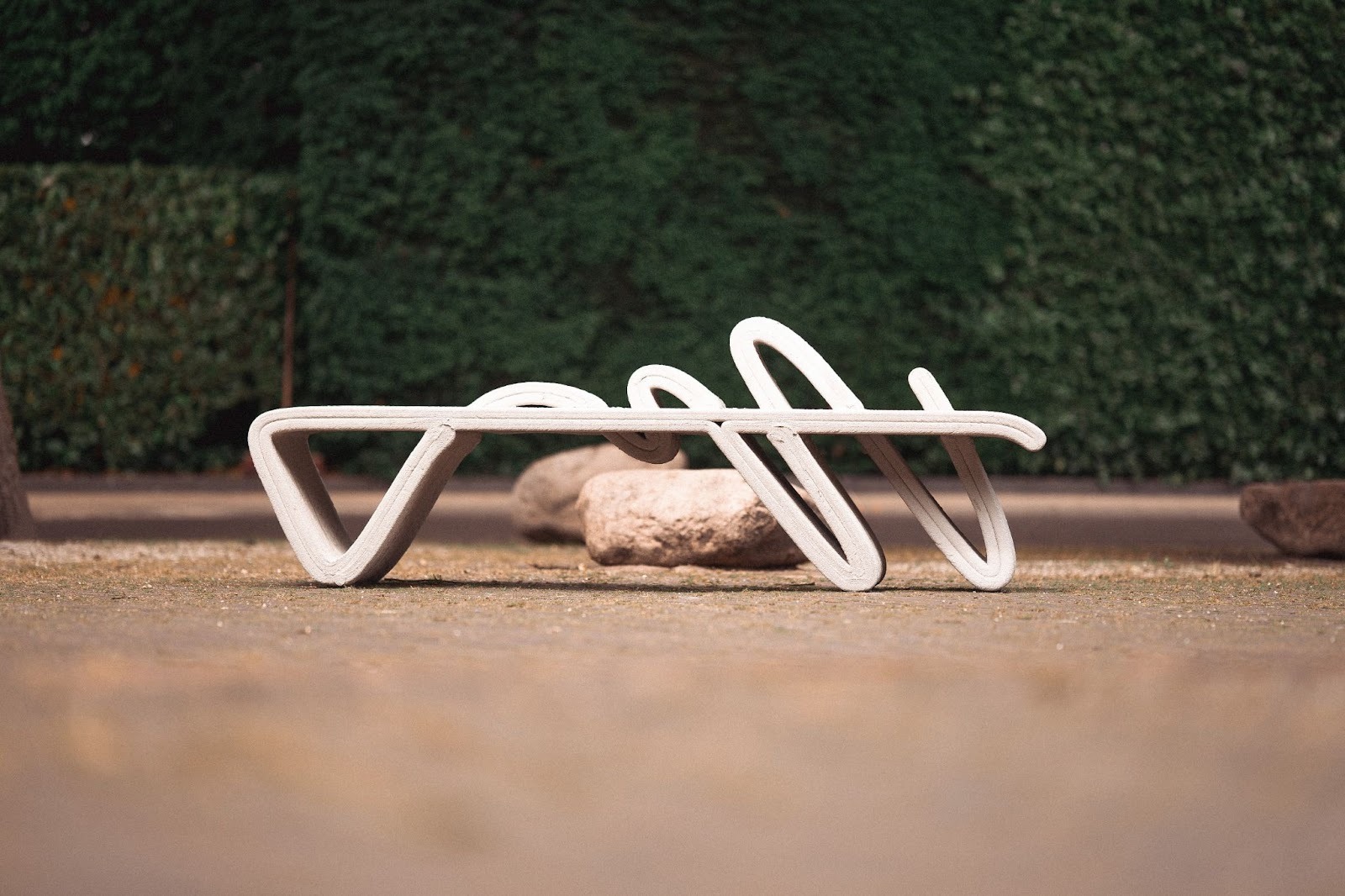
Innovative Applications: From Benches to Biotopes
1. Seating that Guides Flow
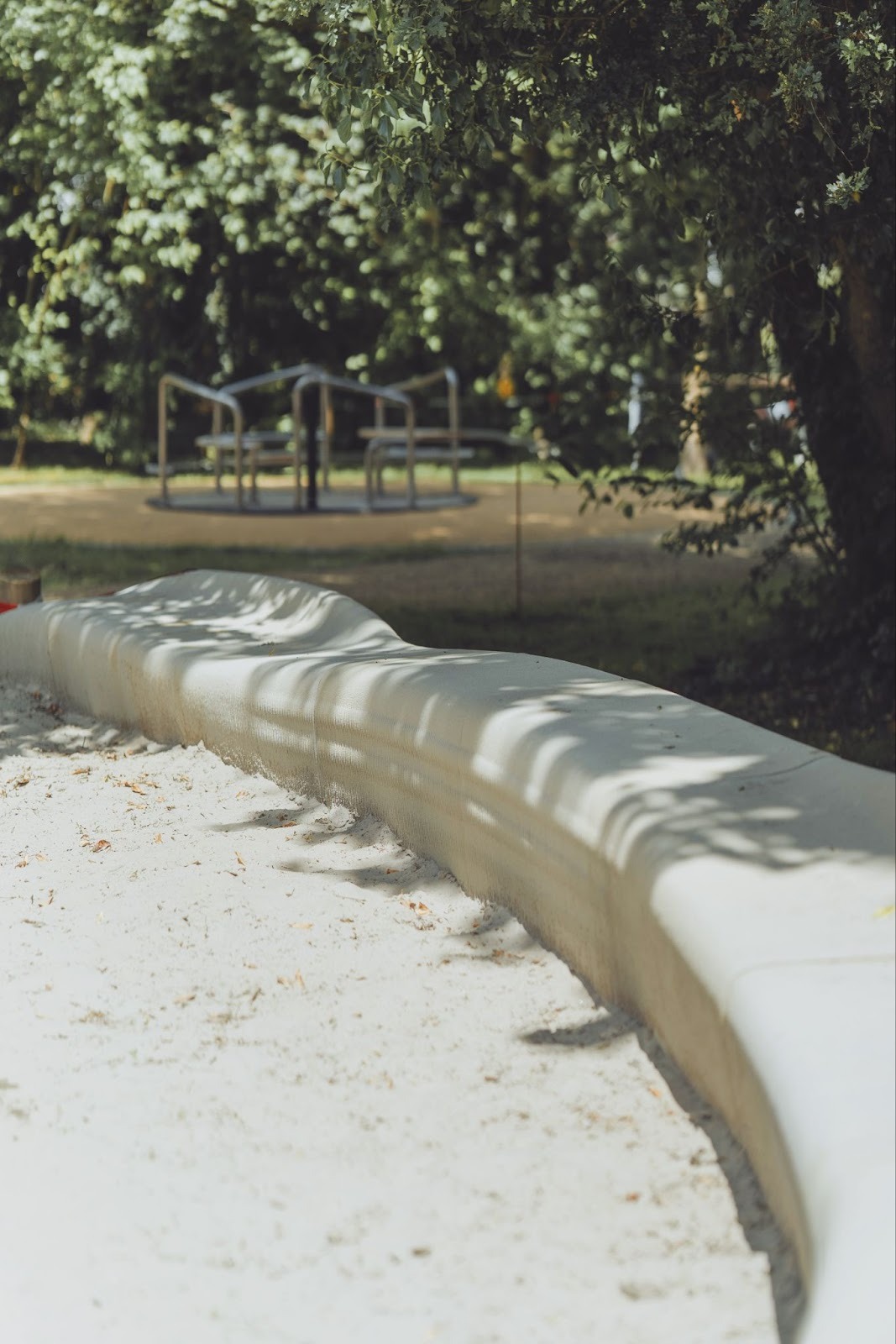
Benches don’t just host people; they choreograph movement. Parametric benches can tighten radius at bottlenecks, widen into plazas, or integrate modular street furniture add-ons like armrests, bike loops, or USB charging trays. Textures create visual rhythm by day and catch raking light by night.
2. Planters as Micro-Infrastructure
Printed planters do more than hold soil. Internal voids become bio-retention cells: gravel sumps, perforated drains, and moisture channels support urban trees and stormwater management. Integrate capillary wicks for drought resilience, or sensor-ready chambers for moisture and nutrient monitoring.
3. Bollards with Purpose
Replace plain cylinders with energy-absorbing lattices tuned to deform on impact while remaining cane-detectable. Embed reflective pigment in the outer layers; route cabling for smart lighting cores. Function meets elegance.
4. Amphitheaters & Sound Pockets
Acoustic scattering textures can be printed directly onto curved backrests to soften speech and music in small public stages. Changes in bead orientation double as ornament and diffuser.
5. Inclusive Design by Geometry
Accessibility is not an afterthought. Tactile contrasts, reachable heights, wheelchair-friendly clear zones, and comfort radii are parameterized and enforced at the scripting level, creating urban design that is inclusive by default.
¹á¹ä§æ
Practical Advantages for Cities and Developers
Speed and Minimal Disruption
Printing near-site reduces logistics. There’s no wait for molds, no lengthy lead times. Phased installations can occur between events or overnight, limiting disruption in dense neighborhoods.
Cost Certainty Through Digital Control
Parametric bills of material are known in advance. Every bead has a line in the spreadsheet. When you change a dimension, the model updates quantities, curing time, and print hours. Fewer unknowns, fewer change orders.
Durability & Maintainability
3D-printed concrete handles abrasion and weather, but maintenance is built in: sacrificial edge bands for skate wear, replaceable inserts where contact is heaviest, and coatings matched to local de-icing salts or marine spray. If damage occurs, components are reprinted from the digital twin no scrapping of entire assemblies.
Security & Vandal Resistance
Hollow, ribbed interiors allow hidden reinforcement, ballast compartments, or anchor cores. Anti-graffiti topcoats and textured surfaces discourage tagging and make cleaning easier without solvents.
Aesthetics with Civic Identity
Because each district can tweak curvature, relief, and color, neighborhoods encode their identity into everyday objects. The city remains unified by a shared toolkit while celebrating local nuance.
Sustainability, Measured Not Marketed
Sustainability claims deserve numbers. With 3DCP, those numbers improve because the workflow touches every lever:
- Material efficiency via topology optimization and hollow sections
- Elimination of single-use formwork
- Shorter logistics thanks to local or near-site production
- Low-carbon mixes using SCMs and recycled aggregates
- Design for disassembly with reversible anchors and modular joints
- Lifecycle data stored in the digital twin to plan refurbishment instead of replacement
Life-cycle assessment (LCA) can be integrated into the parametric model. When a designer thickens a rib or lengthens a bench, the tool returns an updated carbon footprint alongside structural safety factors. Decisions become evidence-based.
Standards, Safety, and the Path to Scale
Innovation succeeds when it meets code. 3DCP street furniture aligns with existing standards by translating printed geometries into analyzable “design analogs.” For example:
- Load cases mirror those for precast seating elements, including concentrated loads (seated individuals), line loads (leaning), and impact (skateboards or trolleys).
- Slip resistance is verified by surface roughness and patterned treads.
- Edge radii & gap limits satisfy safety guidelines to prevent pinch points or snagging.
- Fire performance and material classification follow established masonry/concrete norms.
Where codes lag, performance testing bridges the gap: crush tests for bollards, freeze–thaw cycles for durability, abrasion tests for high-traffic edges. The point is clear: design freedom remains disciplined.
Digital Twins and Civic Operations
Each element can carry a QR tag that links to its digital twin: geometry, mix ID, print timestamp, curing profile, embedded utilities, and maintenance history. Facility teams scan to log cleaning, repairs, or sensor replacements. If a planter is relocated, the digital twin updates the GIS layer. This traceability reduces operational friction and supports circularity respecify, reprint, reinstall.
A Designer’s Palette: Texture, Light, and Color
3D printing is not limited to smooth curves. Bead orientation can create haptic textures that guide visually impaired users. Fine ribbing catches shadow, turning a simple bench into a day-long study of light. Pigments yield warm earth tones or deep charcoals; glass or basalt fibers subtly shift sheen; post-processing can expose fine aggregates for a tactile, stone-like surface. The palette is broad, but the result remains restrained crafted, not loud.
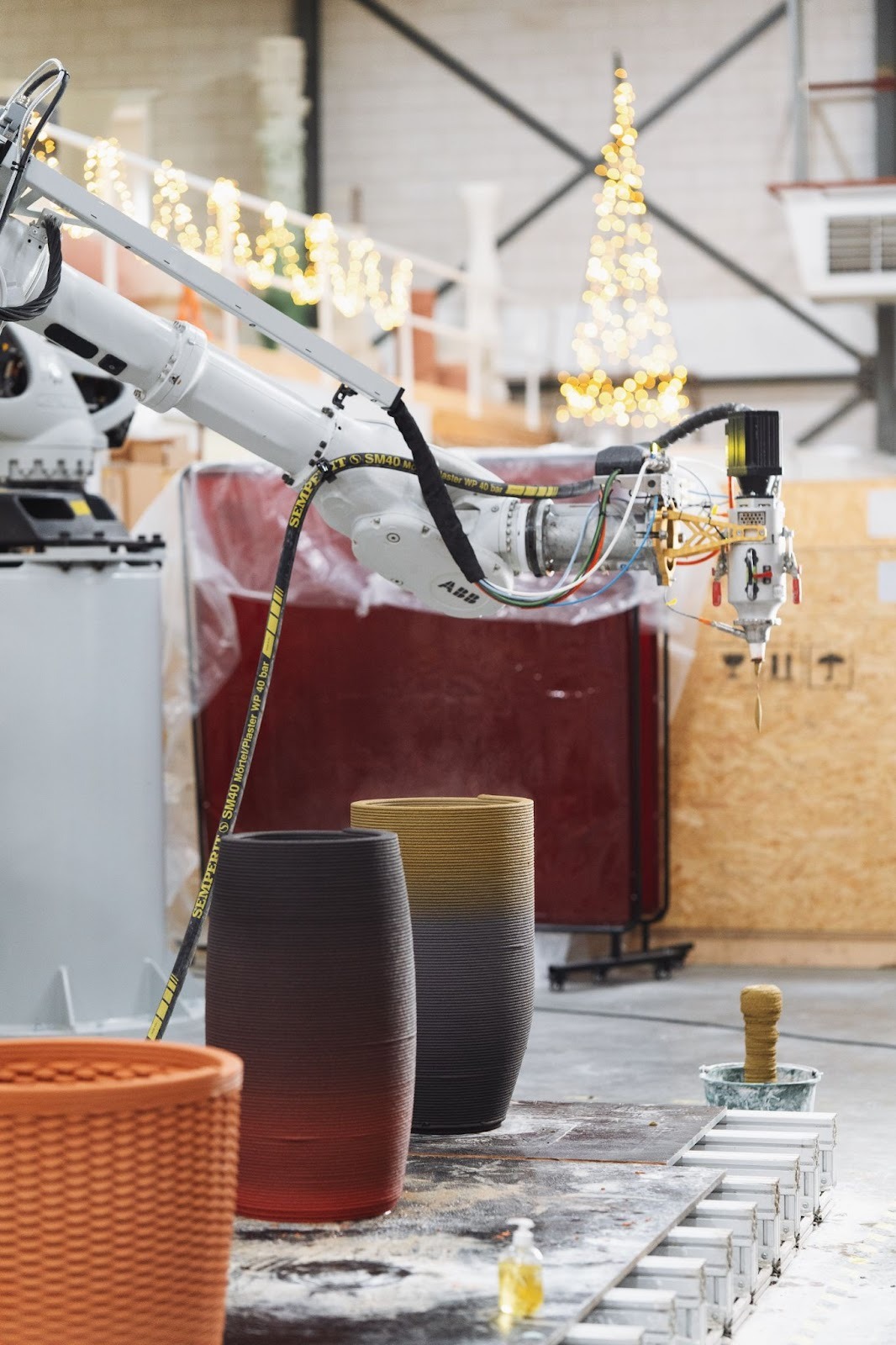
The Business Case: Mass Customization, Predictable Margins
For developers and municipalities, mass customization must pencil out. It does when:
- One parametric family supports many SKUs (bench, planter, bollard, light base) with shared anchors and installation workflows.
- On-demand production keeps inventory near zero while enabling quick swaps and replacements.
- Data-driven design prevents over-engineering: the right amount of material in the right place.
- Local microfactories shorten lead times, diversify supply chains, and create skilled jobs in robotics, materials, and finishing.
The city gets identity and durability; the contractor gets repeatable processes; taxpayers get value.
Future Horizons: Bio-integration and Adaptive Urbanism
Looking ahead, customizable street furniture becomes a platform for adaptive urban systems:
- Bio-receptive surfaces that cultivate moss or micro-habitats, cooling streetscapes and supporting biodiversity.
- Phase-change inserts to smooth temperature swings on exposed seating.
- Embedded photovoltaics in sheltered elements to power lighting and sensors.
- Real-time responsive components whose LED cues shift to manage pedestrian flow during events.
- Cement-free binders geopolymers or limestone calcined clay cements scaled for printability and performance.
As the material palette expands, 3D printing will translate ecological ambition into urban form precise, elegant, and repairable.
Conclusion: Design Freedom with Responsibility
The promise of Customizable Street Furniture: The Design Freedom of 3D Printing is not merely aesthetic. It’s systemic. Parametric design lets geometry answer context. Digital fabrication trades tooling for code. Material science reduces carbon while improving performance. And at the street level where cities are actually felt people meet objects that are comfortable, legible, and distinctly “of this place.”
We stand at a productive intersection of 3D concrete printing, structural logic, and civic storytelling. If the last century optimized the repetition of sameness, this decade optimizes the repetition of difference. The city deserves nothing less.


%20(1).jpg)
%20(1)%20(1)%20(1)%20(1).jpg)
.jpg)
%20(2).jpg)
%20(2)%20(2).jpg)

.jpg)
.jpg)