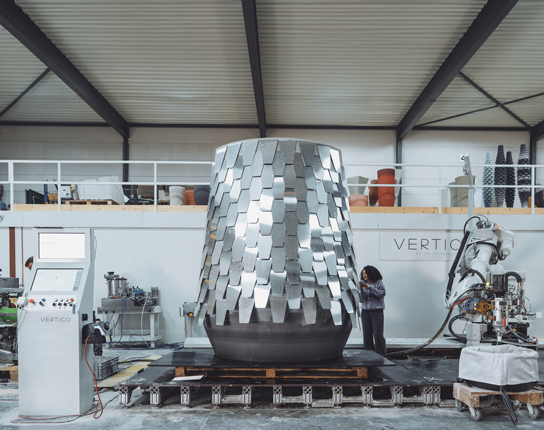
The construction world is buzzing about 3D printed homes: faster builds, lower costs and futuristic designs. How much of that is real today, and how much is still experimental?
This article gives a grounded view of 3D printed housing as it stands now: how it works, what it costs, how long it takes and where the real limitations lie.
What are 3D printed houses?
A 3D printed house is a home whose walls and structural components are built layer by layer by a robotic 3D printer using a custom concrete or mortar mix. Instead of laying bricks or assembling timber frames, the machine extrudes material along precise paths to shape walls, curves and foundations.
Most 3D printed homes still use traditional roofing, insulation, doors and windows. The printing mostly covers the structure.
Gantry-based systems
These are large, fixed-frame setups where the printhead moves along rails, like a giant desktop 3D printer. They are often used to print simple, box-like homes quickly.
- Pros: stable, efficient for mass production, good for identical units.
- Cons: limited design freedom, harder to scale or move to new sites.

Robotic arm systems
These use an industrial robot mounted on a platform to extrude concrete along flexible paths. The robot moves in multiple axes, which allows curved walls, intricate forms and on-site printing. Our comparison of robotic arms vs. gantry systems goes deeper into the trade-offs.

- Pros: highly adaptable, enables organic and parametric architecture, ideal for customized or complex builds.
- Cons: requires advanced software, planning and skilled operators.
How are 3D printed houses built?
Building a 3D printed house can sound like pressing "print" and walking away. In reality the process has several phases and a lot of human coordination.
1. Design and preparation
Everything starts with a digital model. Architects or engineers design the structure in 3D modeling software, often with parametric design tools.
The model is then converted into a printable path with slicing software such as Vertico Slicer, which translates the design into robot movements and material extrusion instructions.
At Vertico, this is where the innovation happens. Parametric design lets us go beyond basic rectangles and explore curves, overhangs and biomimicry-inspired structures.
2. Site setup and foundation
Printing usually begins once a traditional concrete foundation has been poured. Leveling is key: any unevenness in the base throws off the precision of the robotic print.
3. 3D printing the walls
A robotic system, either gantry-based or arm-based, extrudes a custom concrete mix in horizontal layers. It follows the toolpaths created in the design stage and prints everything from straight walls to rounded corners and custom textures.
- Some systems include rebar or reinforcement, while others rely on wall geometry.
- Printing takes hours to days, depending on complexity and scale.
4. Post-processing and integration
This is where reality sets in. Once printing is done, there is still a long to-do list:
- Windows and doors need to be fitted.
- Insulation is installed manually.
- Plumbing and electrical work are added conventionally.
- Roofing is almost always traditional.
Benefits and challenges of 3D printed homes
Common mistakes in 3D printed housing
3D printed housing has made significant progress, but many projects run into avoidable mistakes that affect structural integrity, cost efficiency and overall success. These are the most common ones and how to prevent them.
1. Inadequate material testing and shrinkage issues
- The mistake: not optimizing the concrete mix for 3D printing, which leads to cracking, shrinkage or poor adhesion between layers.
- Why it happens: traditional concrete is not designed for additive layering. Without adjustment it can dry too quickly, causing layer separation, or too slowly, causing deformation.
- How to prevent it:
- Use custom 3D printable concrete mixes with proper setting times.
- Add curing compounds to control shrinkage, as Volker mentions in the interview.
- Run preliminary print tests before large-scale production.
Volker's insight: "Many underestimate the importance of a well-balanced mix. [...] If the material isn't optimized, you'll get cracks, inconsistencies, and a house that won't last."
2. Ignoring structural reinforcement
- The mistake: assuming 3D printed concrete alone is strong enough for multi-story homes or high-stress areas.
- Why it happens: unlike traditional construction, printed walls lack conventional rebar or internal supports. That makes them vulnerable in seismic or high-load conditions.
- How to prevent it:
- Integrate reinforcement strategies, such as steel rods or fiber reinforcement within the printed layers.
- Use hybrid construction methods that combine printed walls with prefabricated reinforcement.
- Consider load-bearing and lateral stability factors during the design phase.
Volker's insight: "The idea that we don't need reinforcement is a myth. The best projects integrate both: printing efficiency with structural strength. That's how you make homes that last."
3. Poor design adaptation to 3D printing capabilities
- The mistake: printing traditional home designs instead of using the specific advantages of 3D printing.
- Why it happens: many architects and engineers repurpose existing blueprints rather than designing specifically for additive manufacturing.
- How to prevent it:
- Use curved and organic shapes, which are more material-efficient in 3D printing.
- Reduce unnecessary overhangs that require excessive support material.
- Design with parametric modeling to optimize wall thickness, insulation and structural efficiency.
4. Overlooking environmental factors
- The mistake: not accounting for climate conditions when printing homes.
- Why it happens: 3D printing behaves differently in humid, dry or extreme temperature conditions. Without adjustment, materials may set unevenly or lose durability over time.
- How to prevent it:
- Adapt printing schedules to local weather, for example by avoiding midday printing in hot climates.
- Use additives or retarders to control drying speed and humidity absorption.
- Implement quality control, such as real-time monitoring of layer adhesion.
Volker's insight: "You can't just drop a printer anywhere and expect perfect results. Climate plays a role. You need to adjust your mix, your curing process, and even the printing schedule to get it right."
5. Underestimating post-processing and finishing time
- The mistake: assuming a printed house is move-in ready right after printing.
- Why it happens: printing only constructs the shell. Plumbing, electricity, roofing, insulation and interior finishing take additional time.
- How to prevent it:
- Plan post-printing processes into the project timeline.
- Integrate modular installations, such as prefabricated electrical panels, to speed up completion.
- Explain the full process to clients and investors to set realistic expectations.
6. Overpromising on cost and speed
- The mistake: marketing campaigns often claim "homes in 24 hours for $10,000," while real-world projects involve hidden costs such as land preparation, labor and material logistics.
- Why it happens: excitement around 3D printing leads to oversimplified cost and time estimates that ignore site conditions, transportation and labor regulations.
- How to prevent it:
- State clearly what the cost and time estimate includes: only the shell, or the full home.
- Use case studies with transparent data to set realistic expectations.
- Work with local construction regulations to avoid unexpected compliance issues.
Volker's insight: "We always hear the '24-hour home' promise, but reality is different. The shell can be printed quickly, yes, but turning it into a livable house? That's a longer process that people need to understand."
How long does it take to 3D print a house?
Headlines often announce "a house printed in 24 hours." The claim is not entirely false, but it leaves out most of the picture.
The concrete shell of a 3D printed house can sometimes be printed in under two days. That is only one stage of a much longer process.
Printing time vs. total build time
Volker's insight: "People always talk about the speed, but that's just the shell. Printing is fast, but finishing the house, making it livable, that still takes traditional construction timelines."
Factors that affect printing time
- Size of the house: a small 40 m² studio prints faster than a multi-room home.
- Printhead type: a 2K printhead allows faster, more complex prints than a 1K printhead (see 1K and 2K in 3D concrete printing).
- Climate conditions: temperature and humidity affect curing and layer adhesion.
- Printer setup: on-site adjustments, calibration and test prints can take hours.
The real answer
In practice, most 3D printed homes take 2 to 6 weeks from start to finish. That is still significantly faster than traditional construction, but far from the 24-hour build often marketed.
How much does a 3D printed house cost?
Printing a home for the price of a car is one of the most compelling promises of 3D printed housing. It is also where most misunderstandings begin.
The "$10,000 home" myth
Media headlines often promote homes for $10,000 or a house printed in 24 hours. Those numbers only reflect the bare printed shell: walls only, with no roof, no finishes and no utilities.
Realistic cost breakdown
Depending on location, design and level of finish, a fully built 3D printed home typically falls in the $80,000 to $180,000 range. Here is how that breaks down:
Note: costs vary significantly by region. This comparison is based on U.S. averages and pilot projects in Europe. Real costs depend on land, permits, materials and finishing levels.
What influences 3D printed home costs?
- Printer type: robotic arm vs. gantry vs. track-based systems.
- Material mix: sustainable concrete or geopolymer blends may cost more.
- Design complexity: curved forms and parametric shapes may save material but increase software and customization costs.
- Location factors: land preparation, permitting and local labor costs still apply.
- Finishing work: plumbing, electrical, HVAC, insulation and roofing are not included in print time or cost.
Bottom line
3D printed homes are not cheap, but they offer long-term efficiency: less waste, less labor and a faster build process.
The real opportunity lies in scalability, custom design and fewer long-term construction bottlenecks, not in cutting corners. More on this in our overview of 3D concrete printing for construction.
Final thoughts: 3D printed housing isn't a magic bullet, but it's a start
3D printed homes are no longer science fiction, but they are not a one-size-fits-all solution either. They offer speed, automation and material efficiency, with limits in design flexibility, regulation and realistic delivery timelines.
To understand the underlying technology, start with our guide to 3D concrete printing.