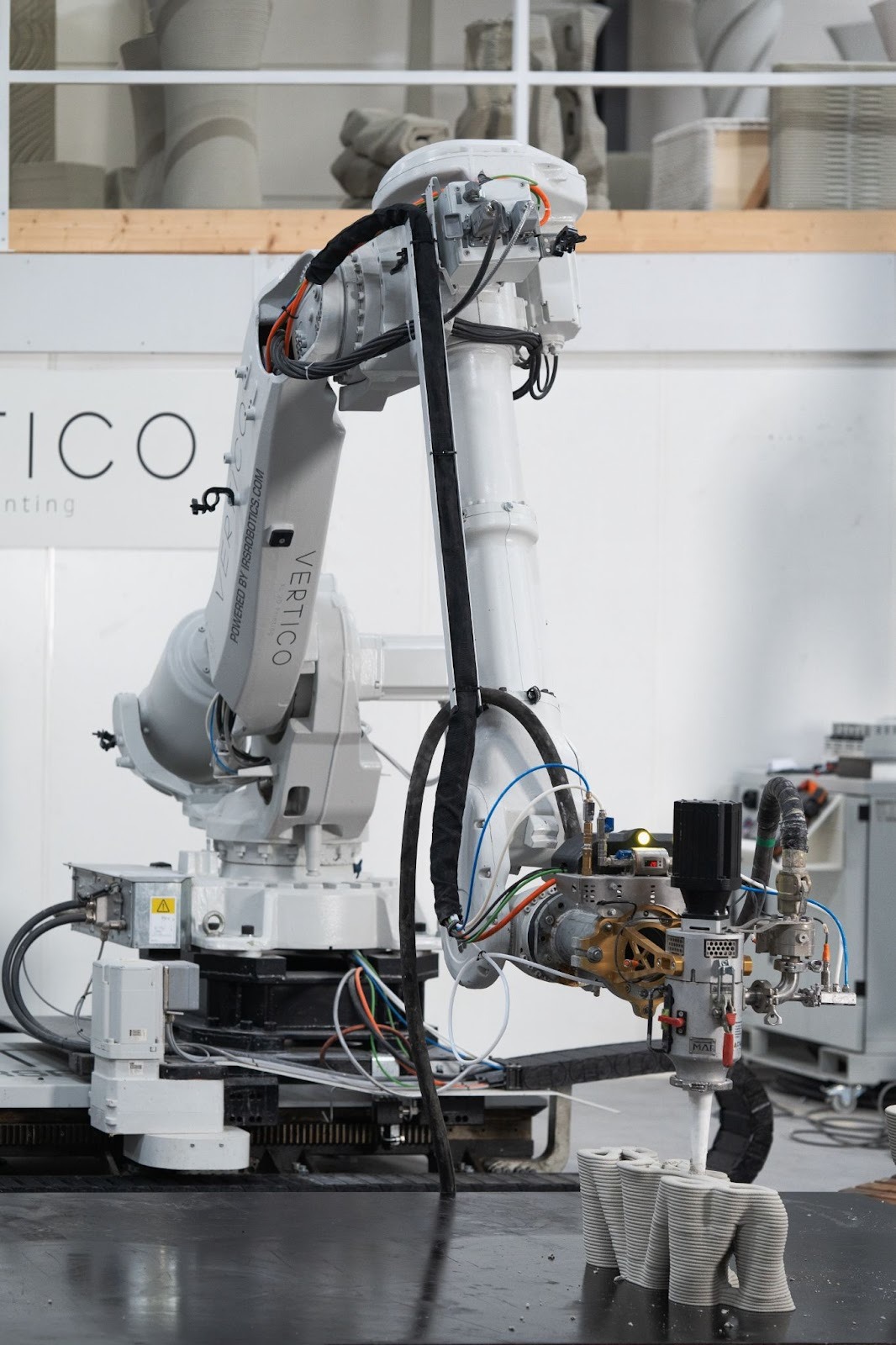
Large-scale 3D printing is no longer a lab curiosity it is a production technology quietly reshaping how we conceive, engineer, and build. In the construction industry, where marginal gains have dominated for decades, large-scale 3D printing delivers a step change: it compresses schedules, unlocks new geometries, and shifts sustainability from slogan to specification. What began as experiments in 3D concrete printing is now maturing into a robust industrial ecosystem combining digital design, robotic deposition, and advanced cementitious mixes to manufacture architecture at the speed of software
.
From Mason’s Line to Machine Path: A Brief Lineage
Architecture has always been an equation between form and force. Roman arches transferred compressive loads through geometry. Gothic cathedrals isolated structure in ribs to liberate light. The 20th century poured fluid concrete into rigid formwork to standardize production. Each leap was powered by a complementary toolset compass, scaffold, rebar, plywood enabling a new family of forms.
Large-scale additive manufacturing extends this lineage. Instead of carving from an oversized block (subtractive) or confining wet concrete in labor-intensive molds (formwork), we deposit material only where it is structurally and thermally needed. A robotic gantry or multi-axis arm translates parametric intent into a continuous toolpath: bead by bead, layer by layer. The logic mirrors nature’s economy bones densify along stress trajectories, shells thicken at supports yet it is authored algorithmically and executed with industrial precision.
This shift from geometry constrained by formwork to geometry generated by data has profound implications. When formwork disappears, complexity becomes affordable. Curves cost the same as straight lines. Variation is free. The “minimum viable form” can align directly with the “minimum necessary material,” turning engineering analysis into a manufacturing strategy rather than a post-rationalization.
The Digital Fabrication Stack: Where Software Meets Structure
At the heart of large-scale 3D printing in construction is a digital fabrication stack that integrates:
- Parametric design to encode intent, performance targets, and constraints.
- Topology optimization to channel forces efficiently and reduce mass.
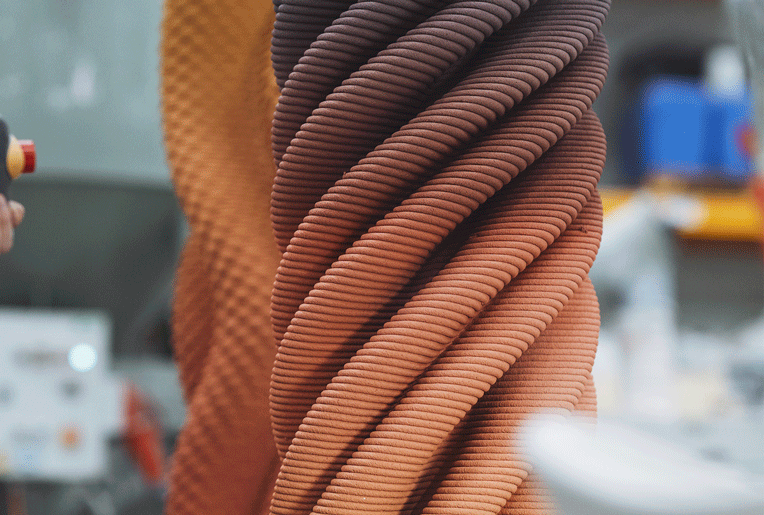
- Toolpath planning to translate surfaces into continuous extrudable trajectories with consistent bead width and controlled interlayer adhesion.
- Robotic motion control to synchronize speed, acceleration, and extrusion rate, safeguarding dimensional accuracy and surface quality.
- Material engineering especially advanced 3D concrete printing mixes to balance pumpability, buildability, green strength, and long-term durability.
Each layer in this stack feeds the next. A change to the thermal cavity of a wall or the radius of a fillet in a structural rib propagates into new toolpaths and revised print times within minutes. This end-to-end continuity reduces coordination risk and unlocks rapid iteration: print a 1:1 corner mock-up today, tune the bead width tonight, and print the full-scale façade panel tomorrow. The result is not just speed, but confidence issues surface digitally, not on-site.
Beyond Formwork: The Innovative Applications Taking Shape
Monolithic Walls with Integrated Performance
Traditional walls partition structure, insulation, and services into distinct layers. Large-scale 3D printing can merge these into multi-material or multi-void assemblies. With a single print head, designers create dual skins with a variable cavity: thicker where thermal bridges threaten, slimmer where structure dominates. The result is a monolithic component that nests structure, acoustic damping, and insulation in one continuous element, reducing trades and touchpoints.
Freeform Structural Elements
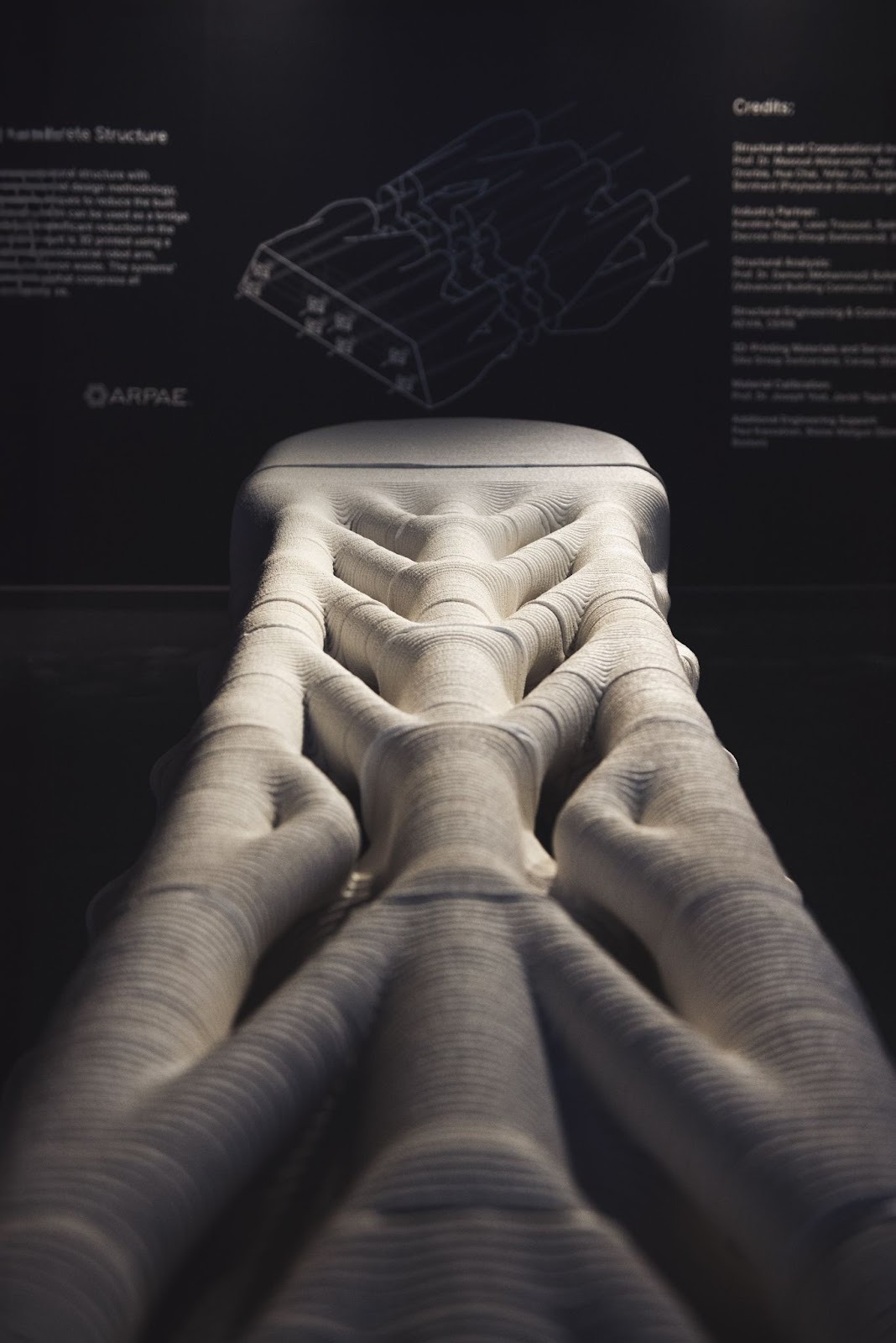
Topology-optimized columns, branching nodes, and ribs once prohibitively expensive become viable. 3D printed formwork (stay-in-place or sacrificial) enables complex reinforced concrete components with 30–60% less material than prismatic equivalents, while controlling crack propagation through curved force paths. In pedestrian bridges and canopies, continuous toolpaths embody the load diagram itself.
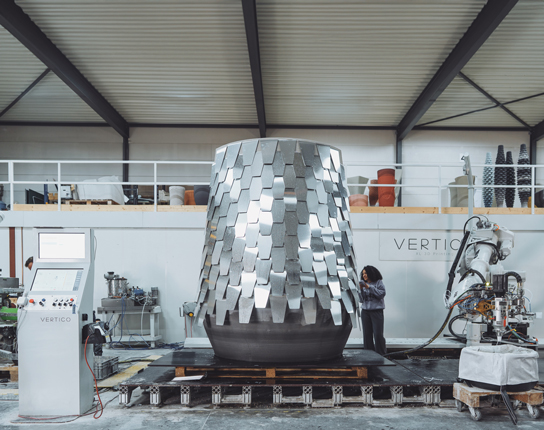
Façade Panels with Functional Ornament
What ornament was to the 19th century, functional texture is to ours. Ribbing can improve stiffness; corrugation modulates light; micro-relief breaks rain splash and grime streaking. Large-scale 3D printing infuses façade panels with performative ornament an aesthetic language born from structural logic, daylighting analysis, and environmental response.
Printable Urban Furniture and Public Realm Elements
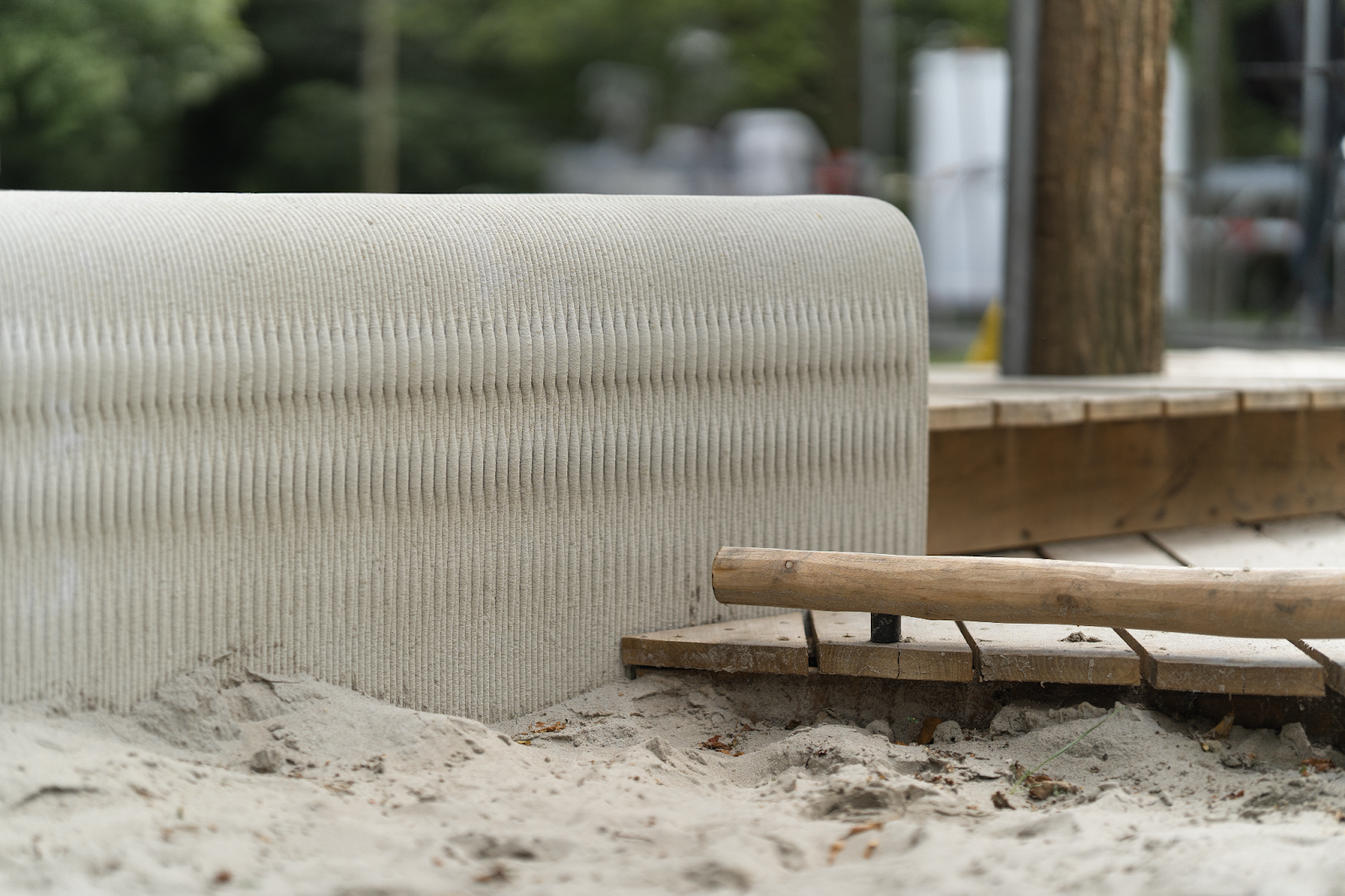
Benches, planters, acoustic screens, bus stops objects traditionally cast in molds or assembled from many parts are ideal early adopters. Their scale fits gantry printers, their curves benefit from additive freedom, and their locations showcase a circular construction model: print with low-carbon cementitious blends, place in service, and design for future disassembly or crushing and reprinting.
Material Intelligence: The Science of 3D Concrete Printing
3D printing in construction hinges on material behavior within seconds, not hours. Mixes must be pumpable (low viscosity under shear), extrudable (consistent bead formation), and buildable (rapid green strength gain to bear subsequent layers). Rheology modifiers, supplementary cementitious materials (SCMs), and fiber reinforcement orchestrate these properties.
- Low-clinker binders: SCMs like fly ash, slag, calcined clays, and finely ground limestone reduce embodied carbon while tuning setting profiles.
- Fibers and recycled aggregates: Improve tensile response and interlayer bonding, opening doors to thinner sections and longer spans.
- Admixture control: On-the-fly dosing linked to ambient data (temperature, humidity, wind) maintains bead geometry across the diurnal cycle.
Crucially, material optimization moves upstream. Instead of pouring a uniform mix and compensating with mass, designers vary bead spacing, wall thickness, and internal cavities to achieve target stiffness with less material. This is performative minimalism strength from shape as much as from substance.
The Productivity Equation: Faster, Safer, More Predictable
On sites where labor scarcity and safety risks coexist, large-scale 3D printing acts like a force multiplier.
- Schedule compression: Printing eliminates multiple trades and waiting times between formwork, rebar placement (where applicable), pouring, and stripping. Walls and cores can rise in hours rather than days.
- Labor efficiency: A compact crew manages batching, pumping, quality control, and robotic supervision. Skilled labor shifts from repetitive placement to high-value oversight and assembly, improving retention and safety.
- Dimensional control: CNC repeatability ensures components align first time, reducing rework and claims.
- Just-in-time logistics: Printing near or on site slashes transport emissions and packaging waste; it also frees projects from mold storage and long lead times.
Sustainability by Design, Not by Afterthought
When sustainability is a by-product, it is fragile. When it is a design driver, it compounds:
- Material reduction through topology optimization and voided sections cuts cement consumption the main source of concrete’s embodied carbon.
- Local production means fewer truck miles and less heavy lifting.
- Design for circularity: Printed components can be mechanically connected rather than monolithically cast in place, enabling disassembly and reuse.
- Thermal performance: Printed cavities tune U-values and reduce operational energy without bulky, multi-trade build-ups.
- Biodiversity and hydrology: Micro-textures on site furniture and retaining elements can foster moss growth, guide runoff, and improve urban microclimates.
In sustainability assessments, these benefits cross-pollinate. Lower mass simplifies foundations. Faster installation shortens generator hours. Fewer trades reduce site waste. The aggregated outcome is a lighter building ecologically, logistically, and economically.
Design Freedom: From Parametric Sketch to Printed Reality
Designers often ask: does 3D printing force a new aesthetic? The answer is subtler: it unlocks latent aesthetics embedded in structural and climatic logic. Consider three patterns:
- Layer Legibility
The bead becomes a design element. Like brick coursing, it records the making. Designers modulate bead spacing to create shadow bands, dampen reverberation, or direct rain. The result is a tectonic honesty the pattern of making enriches the surface. - Continuous Curvature
Curves thrive because printers prefer smooth motion to stop-start corners. Filleted openings, toroidal stiffeners, and gently warped panels deliver higher performance with fewer stress concentrations beauty as a side effect of physics. - Mass Customization
A family of components each unique, all related can respond to orientation, view, wind, or program. Parametric variation costs nothing in tooling. Variation is the new standardization.
Risk, Codes, and the New Normal
No innovation scales without compliance. The path forward combines performance-based design, rigorous material testing, and clear quality control:
- Certification frameworks are emerging around printed concrete mixes, interlayer bond strength, fire resistance, and durability.
- Digital QA/QC links print logs (speed, nozzle height, extrusion rate) to component IDs, enabling traceability and forensic confidence.
- Hybrid systems printed shells with steel or FRP reinforcement ease code approval by aligning with familiar structural models while still harvesting additive efficiencies.
The industry’s learning curve is steep yet navigable. Early adopters are standardizing bead geometries, consolidating toolchains, and codifying print parameters. As precedents grow, permitting accelerates, and the exception becomes the rule.
Business Models: From Prototype to Platform
The mature picture looks less like a single heroic printer and more like a platform:
- Design-for-print consulting paired with BIM integration.
- Mobile print cells that deploy to projects, fed by local batching plants.
- Component marketplaces for walls, stairs, landscape elements, and façade kits configurable online, printed near site.
- Lifecycle services including repair, resurfacing, and eventually disassembly and recycling.
Economically, the trifecta is clear: lower capex in tooling, higher asset utilization (printers move from job to job), and data-driven improvements that compound across projects. The more you print, the better you print.
Case Patterns: What “Good” Looks Like
- Low-carbon housing shells that print in days, integrating ducts and chaseways to minimize post-drilling and noise.
- Pedestrian bridges whose ribbed webs align with principal stress, cutting concrete by up to half while improving aesthetics and constructability.
- Coastal or riverside protection elements with bio-receptive textures, stabilizing banks while encouraging habitat.
- Retrofit panels that wrap existing structures with tailored insulation and shading, extending lifecycle and slashing operational energy.
Each pattern is repeatable and adaptive, not a one-off stunt. That is the hallmark of a technology graduating from novelty to infrastructure.
The Road Ahead: Toward Climate-Positive Construction
Looking forward, three trajectories stand out:
- Materials Decarbonization
Expect rapid progress in cement substitutes, carbon-mineralized aggregates, and reactive fillers that enhance early strength without inflating clinker content. Closed-loop mixes using reclaimed fines from demolition will push us closer to true circularity. - Multi-material Printing
Hybrid print heads will deposit insulating foams, conductive inks, or reinforcement alongside cementitious material embedding function during fabrication. Thermal, acoustic, and electrical performance will be co-printed, not post-installed. - Autonomous Sites
Vision systems, path-planning AI, and real-time rheology sensing will allow printers to compensate for wind, sun, or substrate irregularities. We’ll shift from “operator-led with automation” to automation-led with operator oversight fewer stoppages, more uptime, tighter tolerances.
In this trajectory, construction becomes a software-accelerated discipline. Buildings are compiled, not merely assembled. The industry’s carbon ledger tilts downward as material is saved by design, not sacrificed by compromise.
Large-scale 3D printing is not a silver bullet; it is a precise instrument. In the hands of architects, engineers, and builders who respect both physics and place, it yields structures that are leaner, faster, and kinder to the planet. We inherit the wisdom of arches and vaults and extend it with algorithms and robots. The result is a new vernacular one where performance writes the poetry, and sustainability is embedded in every line of code.


%20(1).jpg)
%20(1)%20(1)%20(1)%20(1).jpg)
.jpg)
%20(2).jpg)
%20(2)%20(2).jpg)

.jpg)
.jpg)