The construction sector has to house a growing world and build its infrastructure while cutting emissions, waste and resource use. Eco-friendly 3D concrete printing offers a path forward. It combines robotic precision with material science to deliver structures that are lighter, faster to build and substantially cleaner.
This is an engineering reality already changing how we conceive, design and build. Construction moves from the age of the trowel to the age of toolpaths, with sustainability encoded in every bead of mortar.
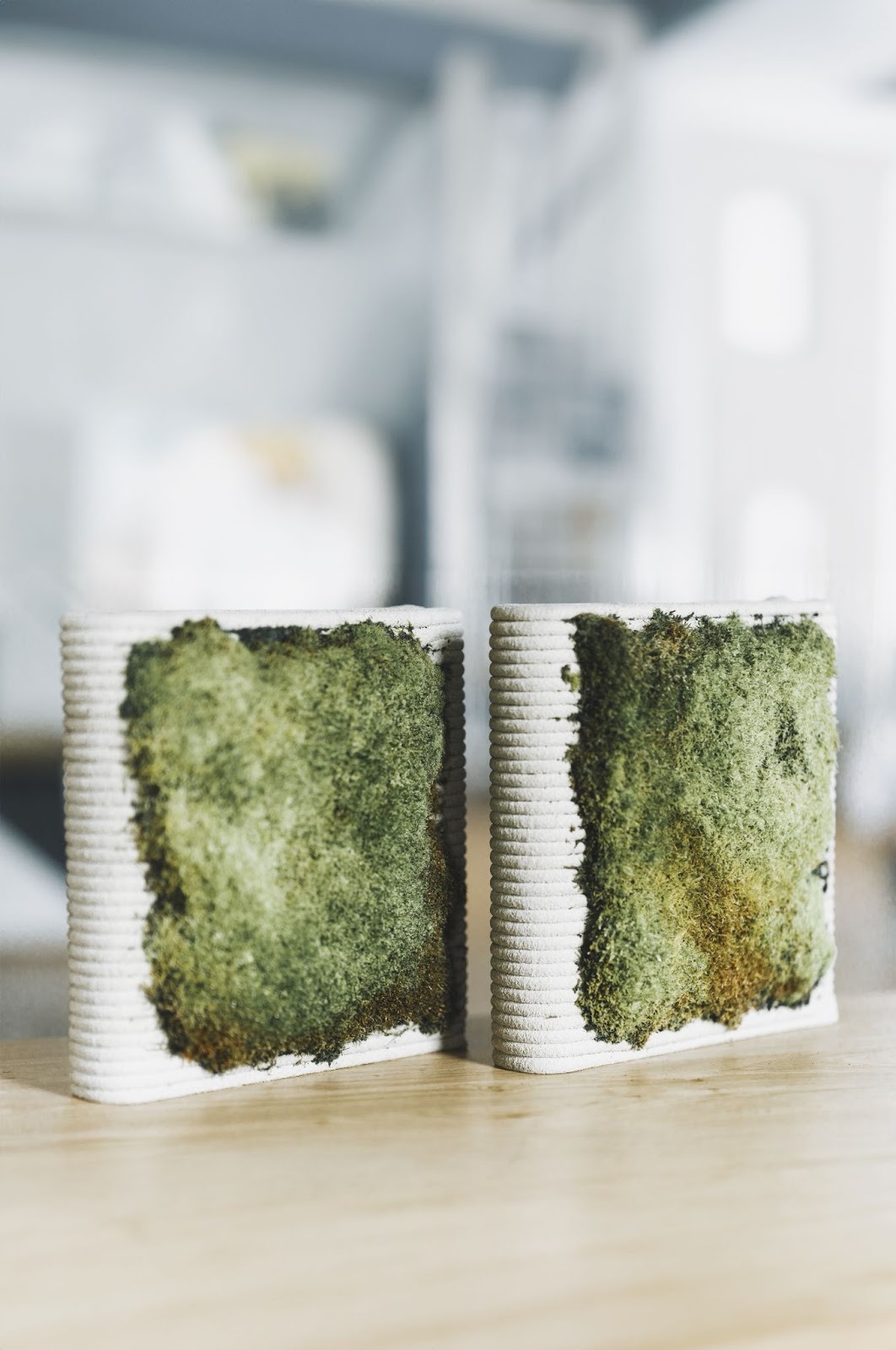
From Roman pozzolans to toolpaths: a short lineage of efficiency
History rewards methods that do more with less. Roman builders blended pozzolans to make durable marine concrete. Gothic masons learned to lift mass off the ground with ribbed vaults and pointed arches. Each leap paired structural intelligence with material thrift.
3D concrete printing is the next chapter in that lineage. Instead of forcing material into shape with formwork, a robotic gantry or arm places material only where it is structurally useful. Geometry becomes a sustainability tool, and layer by layer the printer writes efficiency into the built fabric.
The technical core: why printing reduces environmental load
1. Formwork-free construction means less waste and fewer materials
Conventional casting depends on formwork. Plywood, timber and polymers often become one-off waste. Printing eliminates most of it.
No formwork means fewer temporary materials and fewer transport movements. The outcome is a cleaner site, a slimmer bill of materials and a dramatic cut in construction waste.
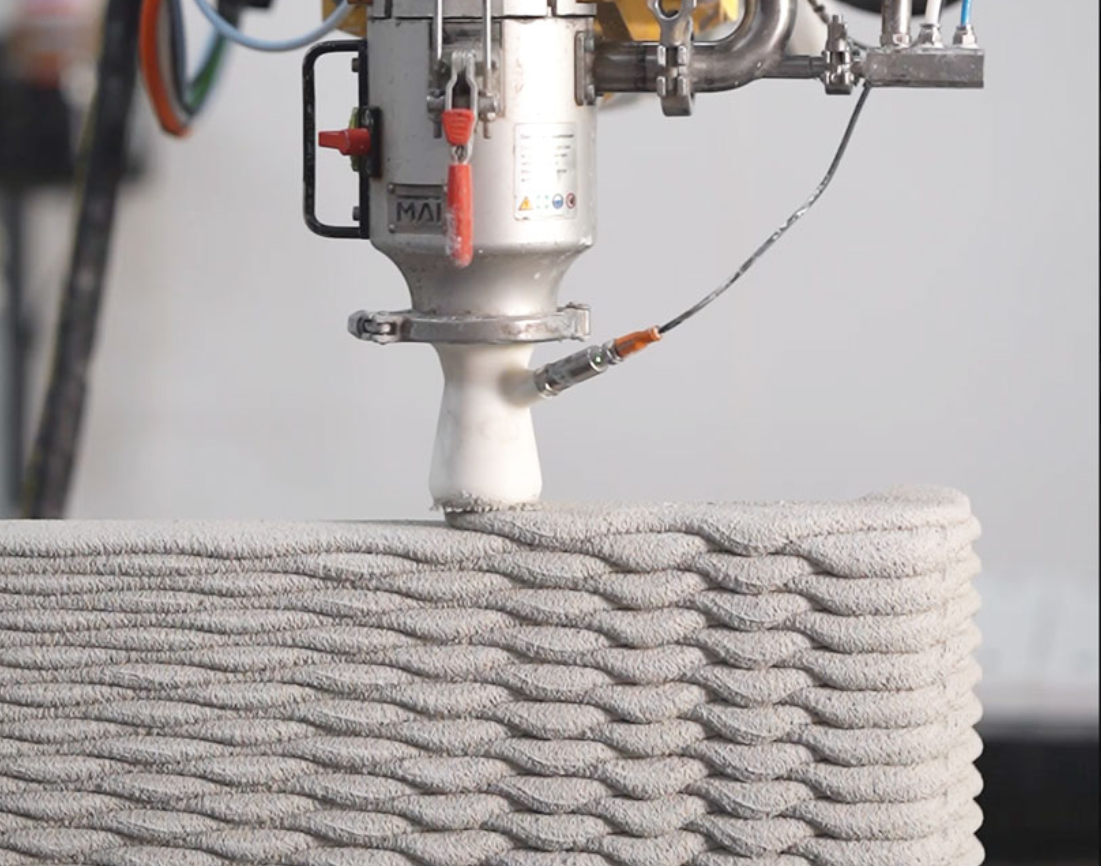
2. Material placed "where the forces flow"
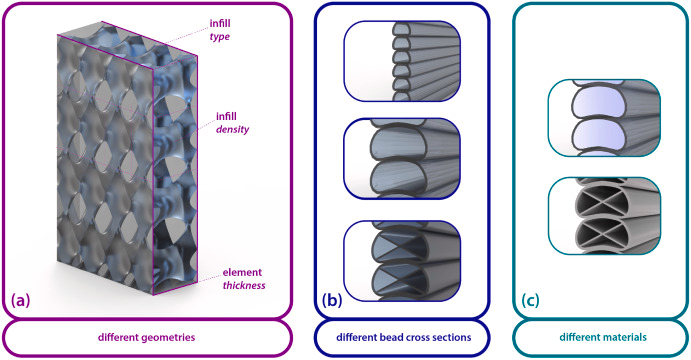
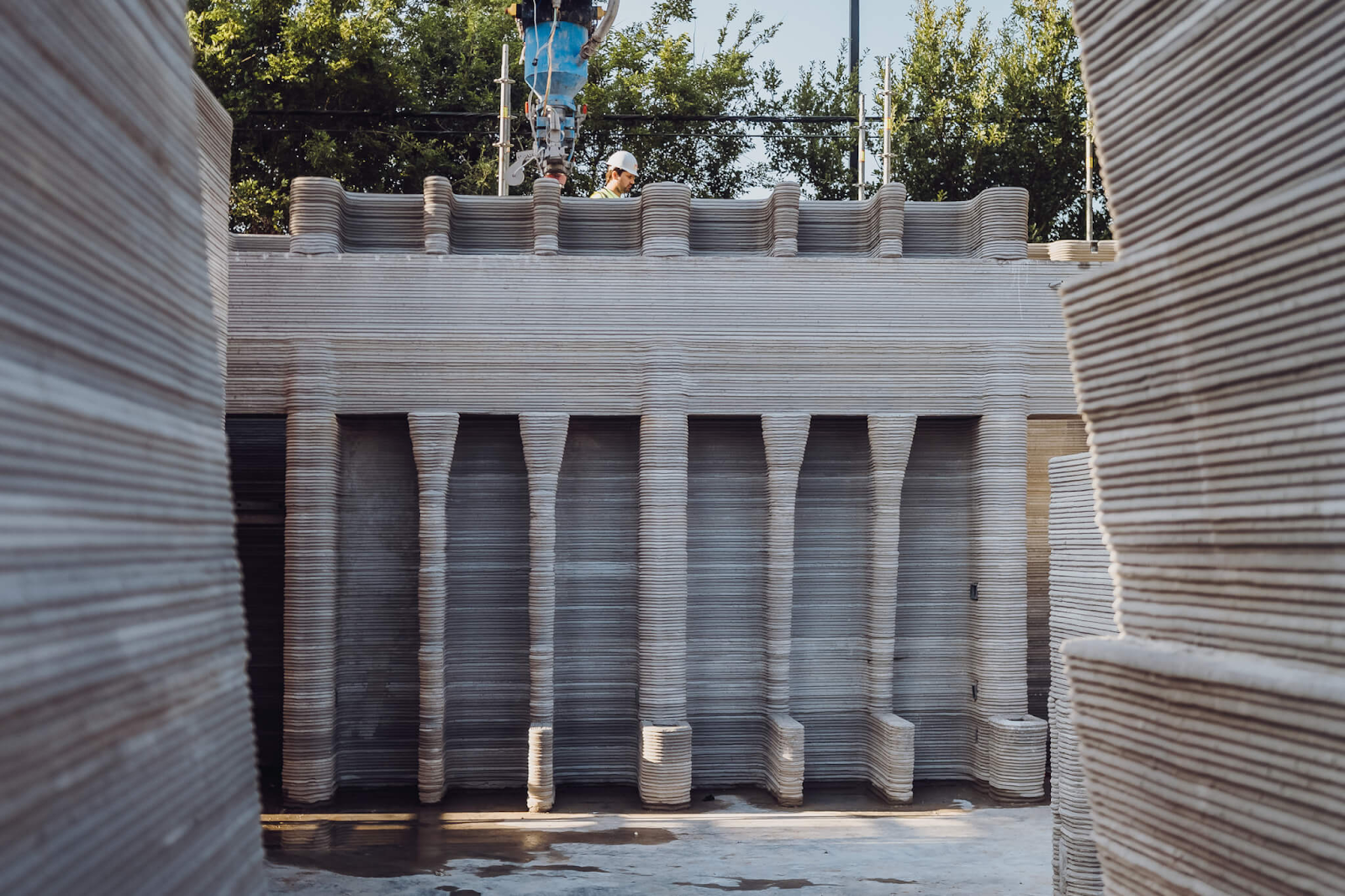
Printers excel at variable cross-sections, corrugated walls, ribbed shells and cellular cores. These are structural optimizations as much as aesthetic choices: they trim volume without sacrificing capacity.
If a conventional wall needs 180 mm of thickness, a printed wall with an internal lattice may achieve similar performance at 120 mm or less. Multiply that reduction across a building, and the embodied carbon savings become tangible.
3. Mix design tuned for sustainability
Eco-friendly 3D concrete printing uses alternative binders and supplementary cementitious materials (SCMs). Ground-granulated blast furnace slag, calcined clay (LC3), finely classified recycled fines and limestone fillers can replace a significant share of Portland clinker, the most carbon-intensive ingredient.
Rheology is key: the mix must be pumpable yet hold its shape once deposited. By engineering thixotropy and early-age buildability with low-dosage admixtures, print performance no longer depends on high cement content. Less clinker means lower CO₂.
4. On-site production, fewer logistics
Printing near or at the point of use removes the distance between plant and project. Fewer truck trips mean lower transport emissions and less urban disruption.
For remote projects, a containerized printer using local aggregates can make the difference between a viable, low-carbon build and a logistics-heavy conventional approach.
5. Energy and time: shorter paths, smaller footprints
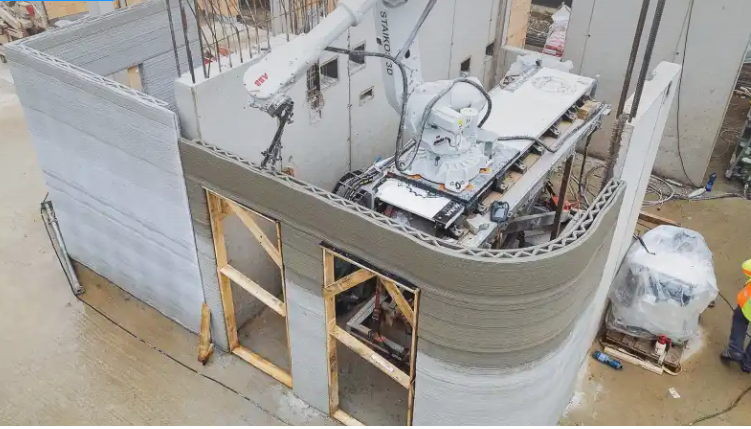
Time is a resource, and energy is a cost. Robots run predictably, even at night on renewable power.
The construction program shrinks because printing consolidates operations: production and assembly happen at the same time. Faster shells, fewer overlapping trades and a cleaner sequence reduce idle time and site energy use.
The design philosophy: sustainability by geometry
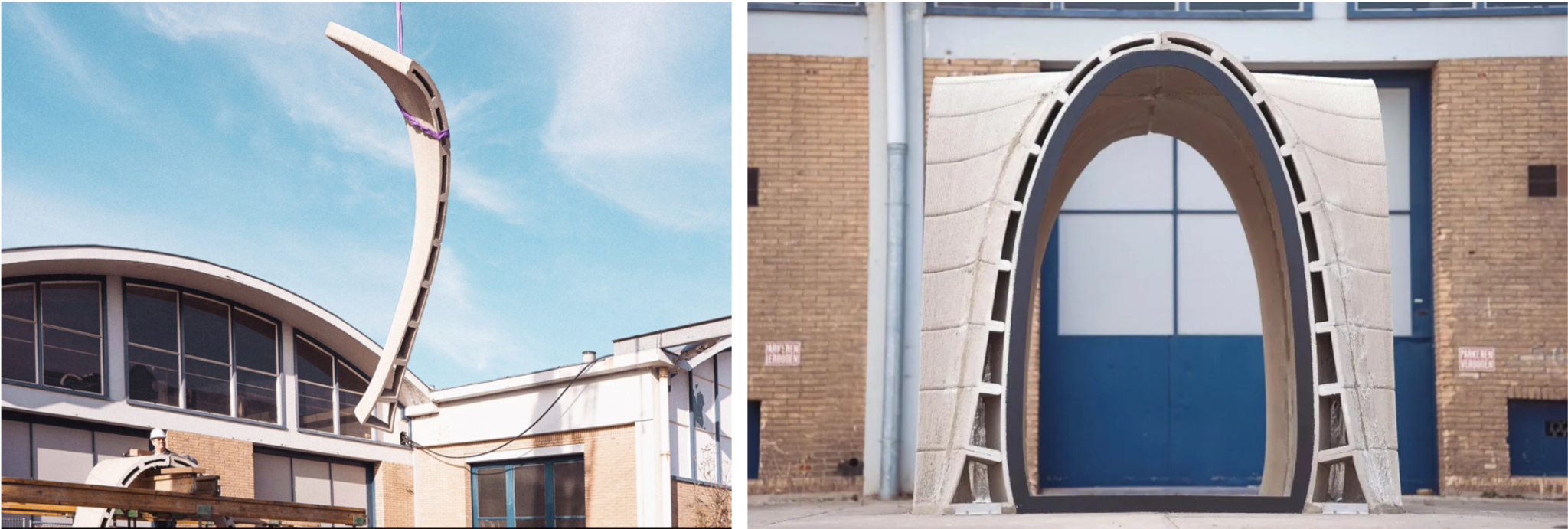
Printing is about designing for deposition, not copying cast forms. Parametric tools encode structural gradients: thickness where bending moments peak, voids where loads are light.
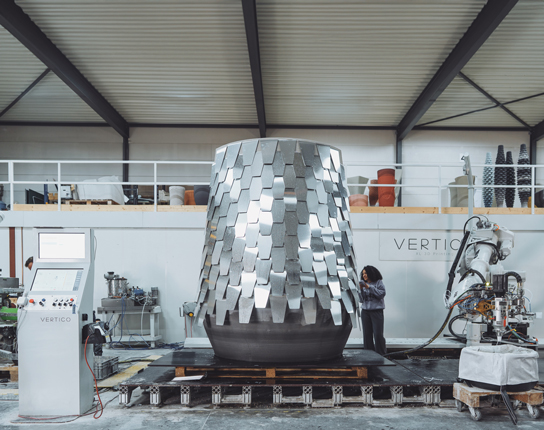
Take a printed façade panel: a double-curved skin with integral ribs, cavities for MEP conduits and acoustic corrugation. The panel becomes a multifunctional component that replaces three or four separate assemblies. That means fewer layers, fewer interfaces, fewer failure points and less material overall.
Here architects and engineers work in the same script. Structural logic (FEA), robotic constraints (nozzle width, layer height, overhang limits) and environmental targets (embodied carbon budgets) become shared inputs.
When a building is sliced like a 3D model in software such as Vertico Slicer, every path is a design decision, and every path can be optimized for sustainability.
Innovative applications that shift the paradigm
Eco-optimized walls and cores
Hollow-core printed walls with periodic internal ribs deliver thermal mass without the weight of solid sections. The cavities can be tuned for insulation infill or passive ventilation. Instead of pouring a monolith, you print a small infrastructure built for performance.
Lightweight bridges and urban furniture
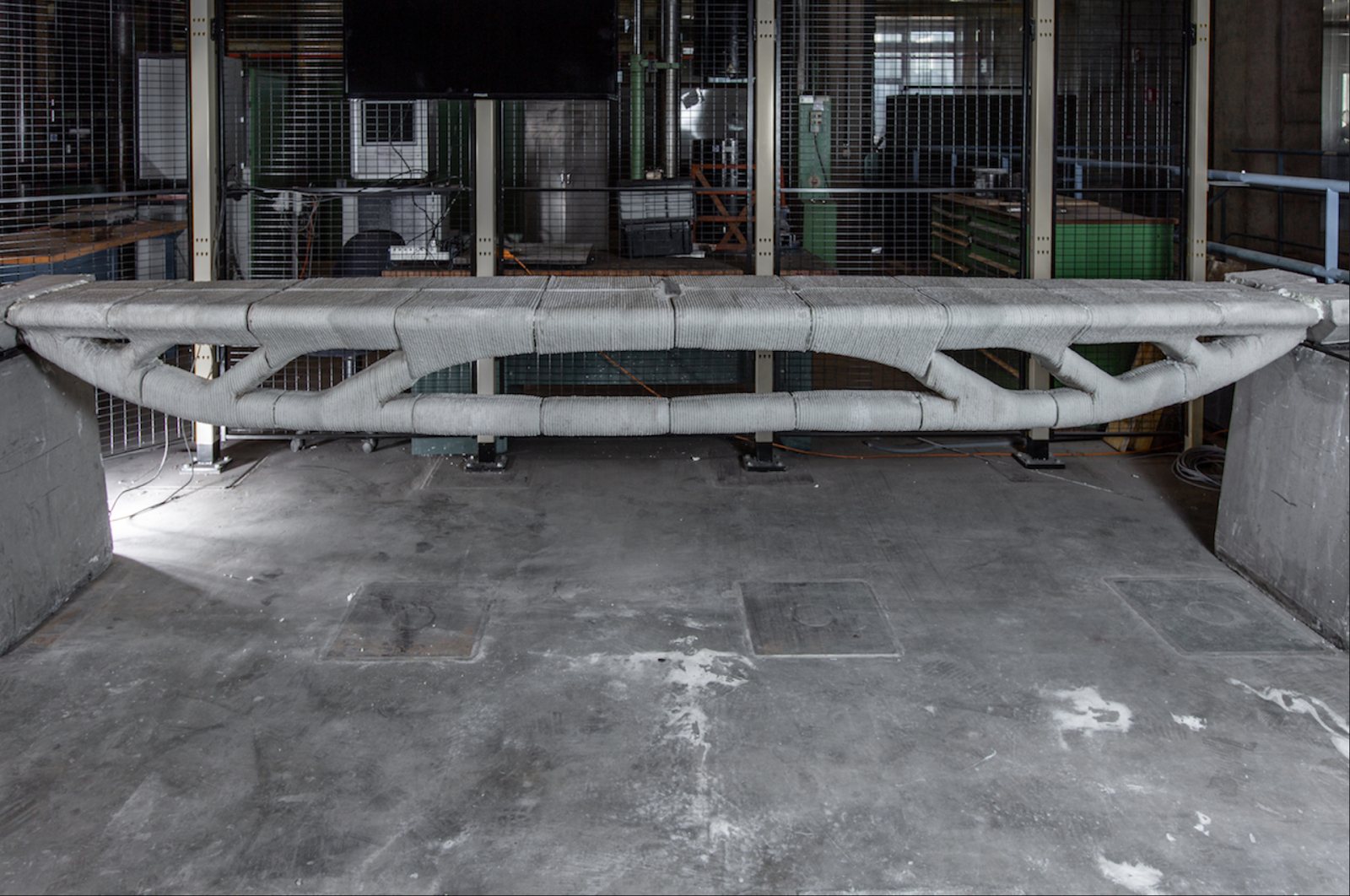
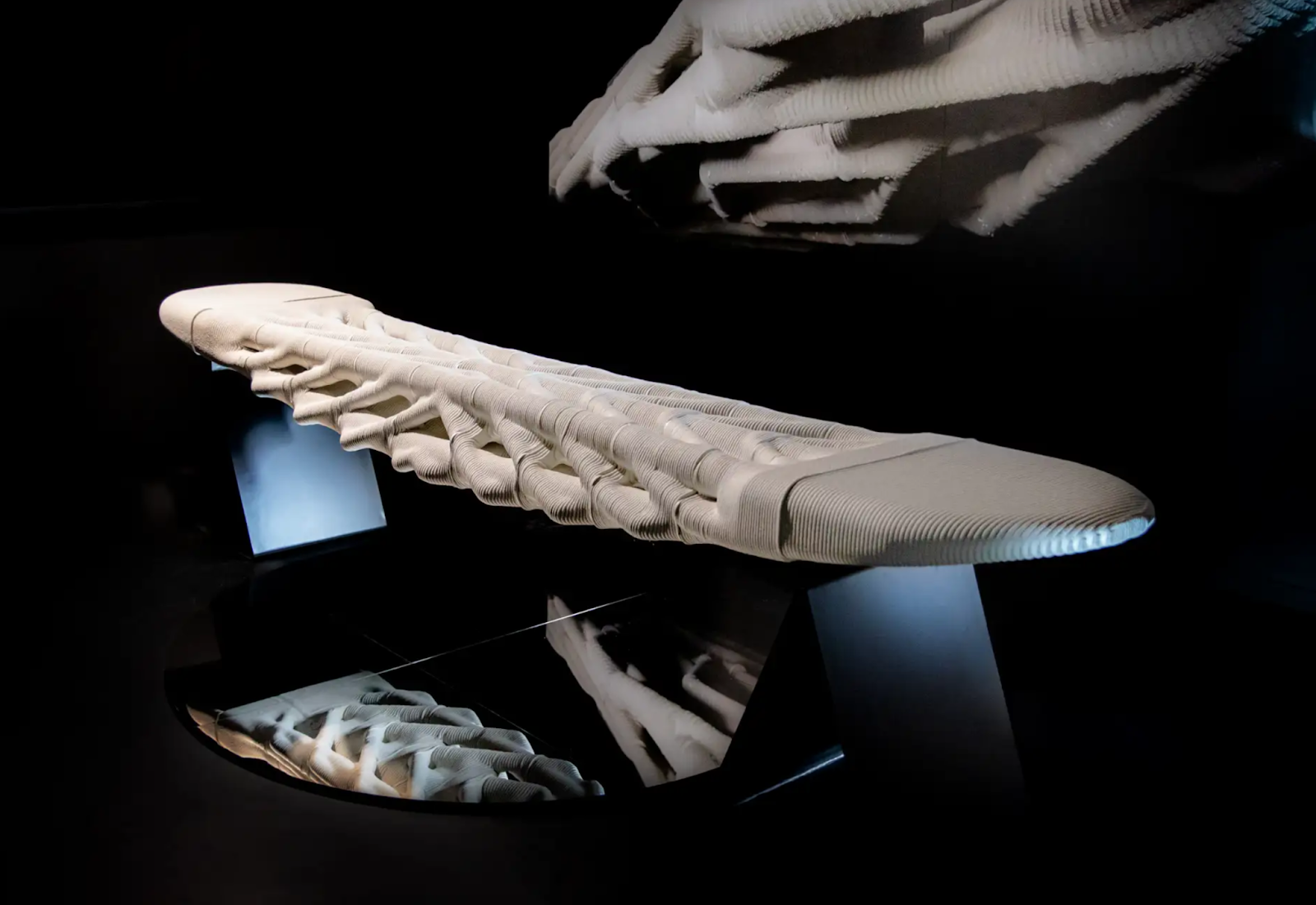
Topology-optimized pedestrian bridges and street elements such as benches, planters and bus stops benefit from complex curvature that is impractical with formwork. With printing, curvature comes at little extra cost.
Complex does not have to mean costly. It can mean resource-smart, which is one reason cities are turning to 3D printed urban furniture.
Foundations with less concrete
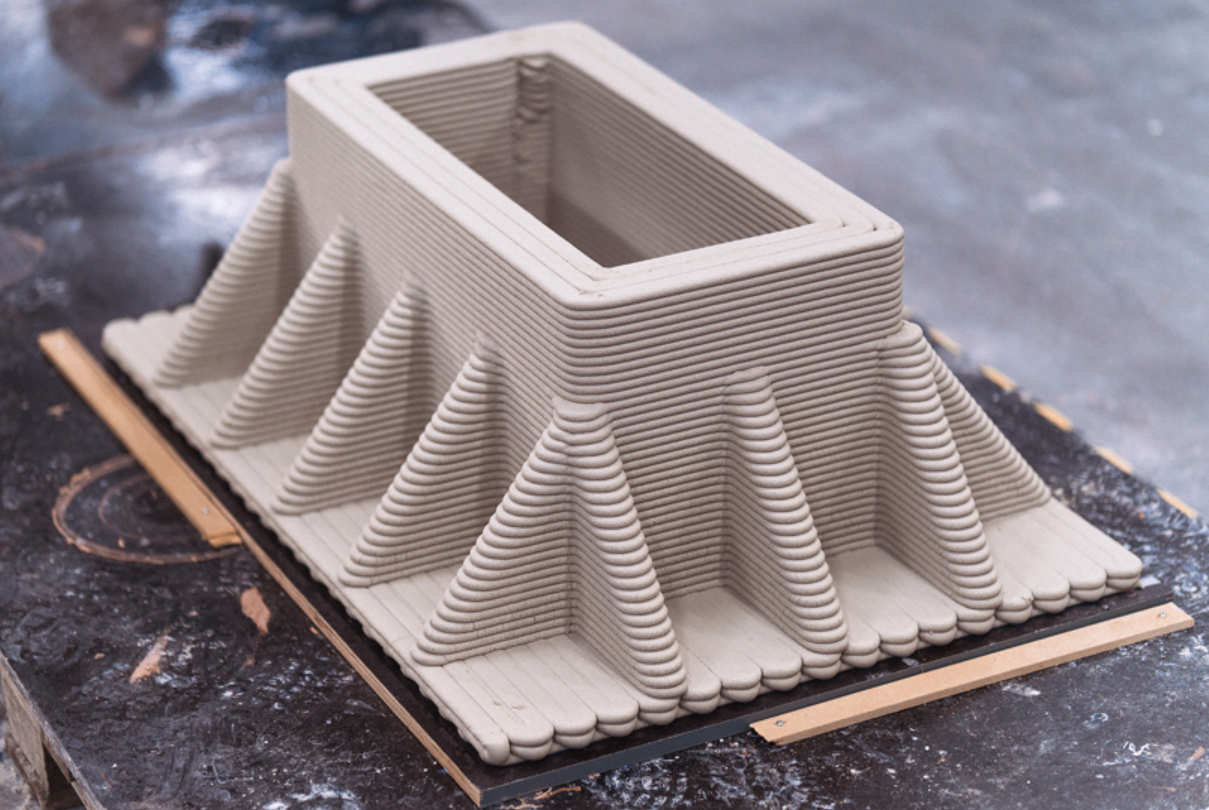
Printed ground beams and pile caps can be ribbed rather than massive, distributing loads efficiently while reducing concrete volume, as in this optimized foundation. Paired with low-carbon binders, this turns the dirtiest part of a build into a cleaner starting point.
Hybrid assemblies
Combine printed cores with bio-based finishes such as timber, cork and hemp panels. Concrete provides structure, fire resistance and mass. Bio-based materials provide warmth and carbon storage.
Printing coordinates this hybrid by embedding connectors and service channels in a single pass.
Practical benefits for builders, designers and the environment
Waste reduction you can measure
Printing is an additive process with almost nothing cut away. There are no offcuts. Returned mix can be reused in non-structural components or recycled as aggregate for future batches.
Less waste means fewer skips, fewer trips and lower fees.
A safer, quieter site
No large formwork systems, fewer lifts and fewer high-risk tasks. Robotic deposition shifts the work from heavy manual labor to supervised automation. Noise and dust decrease, and neighbors and city authorities notice the difference.
Water stewardship
Printable mixes are designed for controlled rheology, not slump-heavy over-watering. With precise batching and closed-loop washout, total water use per cubic meter often declines.
Curing strategies such as membrane-forming compounds, fogging with recycled water or CO₂ curing protect both performance and resources.
Digital continuity from concept to print
BIM-to-print workflows track materials, layer counts and toolpaths with forensic clarity. This digital thread becomes an environmental ledger: embodied carbon reports, take-offs and as-built documentation are produced along the way.
Compliance and certification move faster because the data is already in the model.
Repairability and circularity
Printed components can be designed for disassembly. Interlocking keys, dry joints and accessible cavities allow reuse or refurbishment.
Local damage can be patched robotically with matching mixes, restoring capacity without replacing whole elements. That is the circular economy in practice.
What makes a mix "eco-friendly" for 3D printing?
- Lower-clinker binders: slag, calcined clay (LC3), limestone and recycled fines reduce embodied CO₂.
- Rheology control: yield stress and structural build-up tuned for layer stability avoid over-specifying cement.
- Fine grading curves: optimized particle packing cuts paste demand and water content.
- Admixture intelligence: high-range water reducers and viscosity modifiers deliver flow without excess binder.
- Curing strategies: CO₂ or internal curing (lightweight pre-saturated aggregates) boosts early strength while limiting water and heat.
The headline: sustainability is a system in which materials, robotics and geometry evolve together, not a single ingredient.
Measuring impact: from kilograms to kilograms of CO₂
A credible sustainability claim needs numbers. The framework is simple:
- Define the functional unit, for example "one linear meter of structural wall achieving R-value X and fire rating Y."
- Model geometry precisely. Toolpaths give exact volumes, so there is no guesswork.
- Assign EPD-based factors for binder blends, aggregates, admixtures and energy mix.
- Compare scenarios: conventional cast wall vs. printed ribbed wall, standard cement vs. SCM-rich binder.
- Report transparently: embodied CO₂e, water use, transport distances and waste metrics.
Across many scenarios, printed solutions reduce concrete volume by double-digit percentages. Paired with low-clinker mixes, total embodied carbon can drop further.
The real advantage compounds: geometry, materials and logistics together.
Implementation playbook for project teams
- Start with performance targets, not shapes. Define carbon, cost and schedule boundaries first.
- Prototype fast. Print coupons, panels and junctions to validate rheology and buildability.
- Co-design details. Embed conduits, fixings and thermal breaks directly into prints to avoid secondary works.
- Plan reinforcement early. Choose steel strategies (post-tensioning, discrete bars or fibers) based on load cases and printability.
- Close the loop on waste. Implement return-mix protocols and aggregate recovery from day one.
- Document digitally. Automate take-offs and EPD reporting through the BIM-to-print pipeline.
A vision forward: buildings as printed ecosystems
In the near future, the greenest buildings will be those whose geometry shows material intelligence. Façades will temper light and heat through ribbing rather than applied gadgets. Floor plates will be latticed where bending is low and solid where shear demands it.
Lightweight printed cores will integrate structure, services and acoustics. On site, compact robotic cells will run quietly on renewable power, supervised by crews trained in both craft and code.
Here sustainability works as design freedom rather than a constraint. 3D concrete printing lets designers sculpt performance, build in circularity and deliver architecture that wastes nothing.

Key takeaways for eco-minded decision-makers
- Printing eliminates most formwork and cuts waste.
- Geometry optimization reduces concrete volume at scale.
- Low-clinker binders and tuned rheology cut embodied carbon.
- On-site production trims transport emissions and program time.
- Digital workflows quantify impact and streamline compliance.
- Design for disassembly enables true circularity.
The construction industry needs precise leaps, not incremental change. With 3D concrete printing, structure, sustainability and beauty stop being trade-offs and become the same line of code.


%20(1).jpg)
%20(1)%20(1)%20(1)%20(1).jpg)
.jpg)
%20(2).jpg)
%20(2)%20(2).jpg)

.jpg)
.jpg)